China beauty market Market size and structure
China Beauty Recovery: Who Actually Keeps the Margin
14 min read
On this page
- The five questions I get asked about China profitability
- Is the Chinese beauty market growing again, or is that agency talk?
- If the market grew 6%, why did our China business lose money?
- Who is taking the margin we are not keeping?
- Should we manufacture locally to protect margin?
- What does a profitable China structure look like?
- What changed in the Chinese beauty market
- Who keeps the margin: five layers of the Chinese beauty value chain
- What this means for a foreign beauty brand in China
- Who is winning, and what they did differently
- Who actually buys, and at what price
- How to rebuild a China structure that keeps its margin
- What selling expense ratio is sustainable for a beauty brand in China?
- Sources
China’s beauty recovery in 2026 is real. Cosmetics retail sales at above-threshold retailers reached 244.5 billion RMB in the first half of 2026, up 6.3% year on year, and 309.4 billion RMB over the first eight months, up 6.1% against 3.3% for the same period of 2025 (National Bureau of Statistics, published September 2026). Demand came back.
Profit did not follow the same curve. In the same six months, Shangmei Cosmetics lifted its gross margin to 76.7% and still saw attributable profit fall 79.36%. Giant Biogene held a gross margin near 79.5% and lost 20.5% of its net profit. Meanwhile Nox Bellcow, a contract manufacturer with a gross margin of around 20%, more than doubled its net profit.
That gap is the subject of this article. I walk the China beauty value chain layer by layer, from international groups to listed Chinese brands, ODM suppliers, distributors and platform operators, and show where the money stops. Then I tell you which line of your own P&L is leaking, because it is almost never the one you think.
- 244.5 billion RMB: cosmetics retail sales, above-threshold retailers, H1 2026, up 6.3% (National Bureau of Statistics, July 2026)
- 76.7% gross margin, 66.1% of revenue spent on selling: Shangmei Cosmetics, H1 2026 (company interim results, August 2026)
- 53.13%: Proya’s selling expense ratio in H1 2026, against 49.59% a year earlier (company interim report, August 2026)
- +105.55%: net profit growth at ODM manufacturer Nox Bellcow, H1 2026, on revenue of 1.107 billion RMB, up 18.16% (company interim report, August 2026)
- 60 points: commission a beauty brand now pays a top livestream host, against about 40 points in 2024 (industry testimony, September 2026)
The five questions I get asked about China profitability
In the words finance directors actually use.
Is the Chinese beauty market growing again, or is that agency talk?
It is growing. The numbers are below, with the monthly pattern, because the average hides a lot.
If the market grew 6%, why did our China business lose money?
Gross margin is not the constraint in this category. Customer acquisition is. The value chain table shows the split.
Who is taking the margin we are not keeping?
Partly your suppliers, mostly your traffic. I name both, with figures.
Should we manufacture locally to protect margin?
It helps your landed cost. It will not fix a selling expense ratio above 50%.
What does a profitable China structure look like?
Smaller, slower, with owned channels carrying more of the volume. The solutions section gives budgets.
What changed in the Chinese beauty market
The recovery is broad but modest, and it is lumpy month to month. Cosmetics retail sales at above-threshold retailers grew 2.5% in May 2026, jumped 12.6% in June on the 618 festival, then settled at 6.8% in July and 4.9% in August (National Bureau of Statistics, September 2026). A brand that builds a China forecast off the June number will miss its year.
On total market size, two credible sources do not agree, so here is both. The China Association of Fragrance, Flavour and Cosmetic Industries puts H1 2026 cosmetics sales at 610.6 billion RMB in total, split between 380.9 billion RMB online, up 5.74%, and 230.5 billion RMB offline, up 2.13% (CAFFCI, September 2026). Separate channel trackers quoted in Chinese financial press in September 2026 put online growth at 10.1% and online penetration at 56.9%. Take the range: online is growing somewhere between 6% and 10%, offline is barely moving, and online now carries a little over half the category.
| Indicator | H1 2026 | Change vs H1 2025 | Source |
|---|---|---|---|
| Cosmetics retail, above-threshold retailers | 244.5 bn RMB | +6.3% | National Bureau of Statistics, July 2026 |
| Total cosmetics sales, online | 380.9 bn RMB | +5.74% | CAFFCI, September 2026 |
| Total cosmetics sales, offline | 230.5 bn RMB | +2.13% | CAFFCI, September 2026 |
| Cosmetics retail, January to August | 309.4 bn RMB | +6.1% | National Bureau of Statistics, September 2026 |
Two things got worse while the market got better.
Traffic prices rose. A Chinese beauty brand founder quoted in September 2026 said that a commission of about 40 points was enough for influencer livestreams in 2024, and that by 2025 the number was basically 60 points. Standard rates sit at 25% to 30% of consumer payment, pure commission deals start at 35%, and beauty specifically runs at 40% and above. Slot fees start around 3,000 RMB per product link and reach 30,000 RMB and more with head hosts.
Price discipline weakened. Chinese analysts describe the phase as stock competition rather than growth, with consolidation toward brands holding real registration and R&D capacity. The category grows while individual price points stay under pressure, which is the worst combination for a brand that buys its volume.
Who keeps the margin: five layers of the Chinese beauty value chain
I compared the most recent published results of one company per layer. This is where the article earns its keep.
| Layer | Company | Gross margin | Latest revenue | Latest profit trend |
|---|---|---|---|---|
| International group | The Estée Lauder Companies, Mainland China | Not disclosed by market | +9% organic, FY2026 | Share gains every quarter of FY2026 |
| Listed premium C-beauty | Mao Geping | 84.2% (FY2025) | 5.051 bn RMB, +30% (FY2025) | Net profit 1.205 bn RMB, +36.8% |
| Listed mass C-beauty | Shangmei Cosmetics | 76.7% (H1 2026) | 3.756 bn RMB (H1 2026) | Attributable profit 108 m RMB, -79.36% |
| ODM manufacturer | Nox Bellcow (formerly Qingsong) | 20.55% (FY2025) | 1.107 bn RMB, +18.16% (H1 2026) | Net profit 56.34 m RMB, +105.55% |
| E-commerce operator (TP) | Lirenlizhuang | 39.76% (FY2025) | Not restated here | Margin recovered from 27.06% in 2022 |
Sources: company annual and interim reports 2025 and 2026; Zhiyan Consulting comparative analysis of listed Chinese cosmetics companies, published 12 August 2026; Estée Lauder FY2026 results, August 2026.
Read that table twice, because it kills the lazy version of the thesis. Suppliers do not hold the margin. An ODM at 20.55% against Mao Geping at 84.2% is not a close contest. Brands own the pricing power in this category and always have.
What suppliers own is margin direction. Nox Bellcow turned 18% revenue growth into 105% profit growth because its costs are fixed assets and labour, and volume dilutes them. Its client list includes P&G, Unilever, Estée Lauder, Sephora, Watsons, Shiseido and Nivea, so the recovery reaches it with a one-quarter lag and no acquisition cost attached. It also lifted gross margin 3.13 points to 20.55% in 2025. Low margin, rising, geared to volume.
Brands own high margin, falling, geared to traffic. Zhiyan Consulting’s August 2026 comparison of listed Chinese cosmetics companies makes the point in one line: sector gross margin is generally high, but internal dispersion is extreme. Giant Biogene 80.34%, Fuerjia 80.06%, Botanee 74.46%, Wanmei 74.29%, Proya 73.26%, all 2025. Then look at what happens between gross margin and net profit.
| Brand, H1 2026 | Revenue | Gross margin | Selling expense as % of revenue | Net profit |
|---|---|---|---|---|
| Proya | 5.375 bn RMB, +0.24% | 74.32% | 53.13% (from 49.59%) | 1.168 bn RMB, +46.26%, of which 445 m RMB investment gain |
| Giant Biogene | 2.918 bn RMB, -6.3% | ~79.5% | 43.4%, spend +19.7% | 940 m RMB, -20.5% |
| Shangmei Cosmetics | 3.756 bn RMB | 76.7% (from 75.5%) | 66.1% (from 56.9%) | 108 m RMB, -79.36% |
| Botanee | 2.592 bn RMB, +9.27% | 74.46% (FY2025) | Not restated | 292 m RMB, +18.30% |
| Lin Qingxuan | 1.5 bn RMB, +42.6% | Not disclosed | Not disclosed | 256 m RMB, +40.7% |
Sources: company interim reports and results announcements, August and September 2026.
Proya deserves a note, because its headline looks like a win. Net profit up 46.26% on revenue up 0.24% is not operating performance. It includes a 445 million RMB investment gain from consolidating Flower Knows, and profit excluding non-recurring items fell 13.8%. Both its main brands declined. That is a company buying growth at the holding level while its selling expense ratio climbs almost four points in twelve months.
Shangmei is the cleanest warning. Gross margin improved. Selling and distribution spend of 2.48 billion RMB swallowed 66.1% of revenue, up from 56.9%. Profit fell by nearly four fifths. Nobody upstream stole that margin. It was spent.
What this means for a foreign beauty brand in China
Your gross margin in China is probably fine. An imported premium skincare product sold cross-border usually lands between 65% and 80% at gross level, the same band as the listed Chinese brands above. Stop benchmarking that line.
Benchmark the line below it. If your China selling costs, all in, run above 50% of China revenue, you are structurally where Proya is, without Proya’s scale to absorb it. Above 60%, you are where Shangmei is, and Shangmei lost 79% of its profit.
The costs that leak, in the order I find them:
- Livestream commissions and slot fees. A beauty brand paying 40% to 60% of consumer payment to a host, plus a slot fee, plus the platform cut, has no path to contribution margin. This is the single biggest line I cut on arrival.
- Paid social on borrowed audiences. Repeated acquisition of the same profile at rising cost, with no owned relationship at the end of it.
- Promotional depth during festivals. A June that grows 12.6% at 40% off is not a good June.
- Agency and operator layers stacked on each other. A TP operator earning 39.76% gross margin is earning it on your revenue.
- Registration and compliance rework. Not large, but it delays everything downstream, and delay is the most expensive thing in this market.
On platforms, be precise. They take a real cut, but they are not printing money this year either. Alibaba’s customer management revenue fell 7% year on year in the June 2026 quarter, and would have grown 1% like for like excluding a new business development programme (Alibaba results announcement, August 2026). The people reliably converting your spend into their profit are the intermediaries between you and the consumer: hosts, agencies, operators and the manufacturers behind your competitors.
Who is winning, and what they did differently

Market share has shifted toward Chinese brands, but share and profit are no longer the same story.
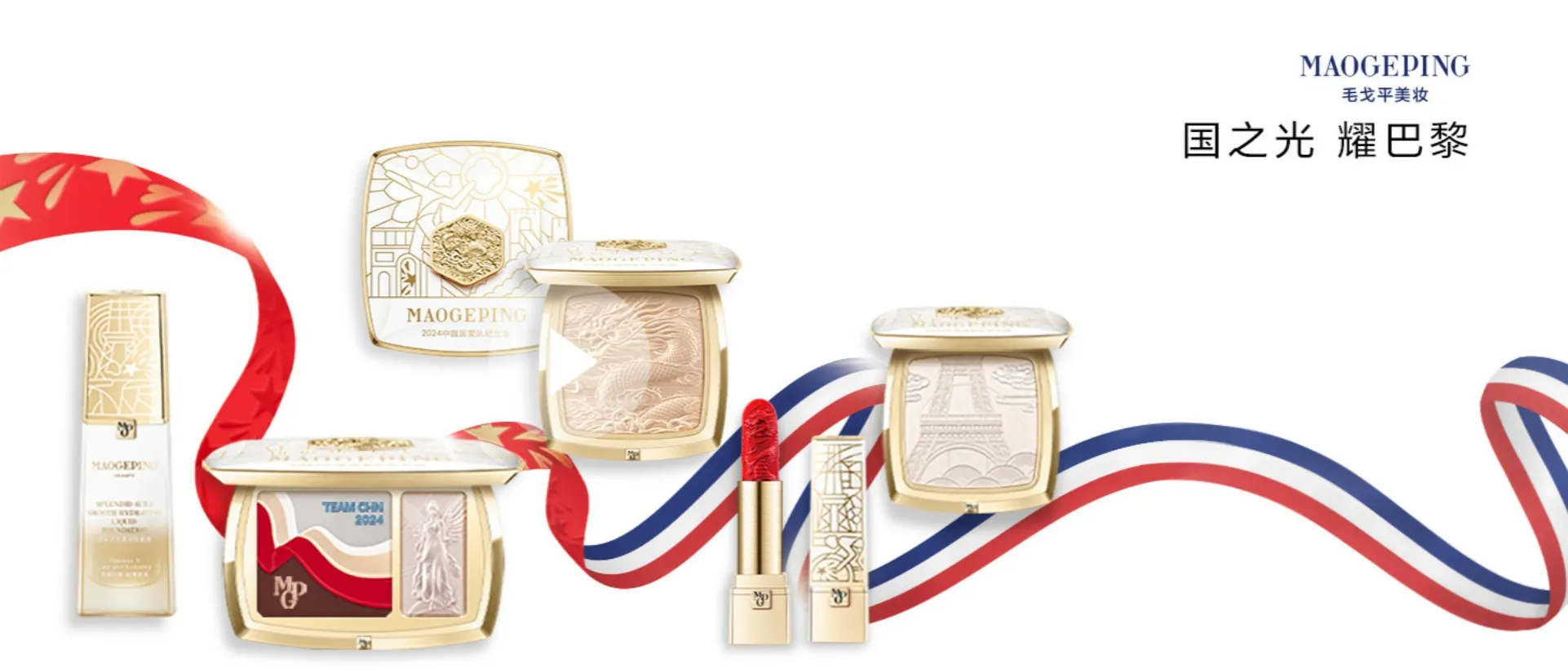
Mao Geping ran the premium playbook properly. FY2025 revenue of 5.051 billion RMB, up 30%, net profit of 1.205 billion RMB, up 36.8%, and a gross margin of 84.2%, the highest among Chinese beauty peers (company annual report, March 2026). Skincare reached 1.873 billion RMB, up 31.1%, at an 87.3% gross margin. Online passed half of revenue for the first time at 2.477 billion RMB, up 38.8%. What made it work: counter service and makeup artistry created a reason to pay a premium that no discount code replicates. A smaller brand can copy the service layer. It cannot copy a founder who is a household name in Chinese makeup.
Estée Lauder grew Mainland China organic net sales 9% in fiscal 2026 and gained prestige beauty value share every quarter, across fragrance, skincare and makeup (company FY2026 results, August 2026). The mechanism was portfolio breadth plus fragrance, a category where discounting pressure is lower and gift purchase holds price. If you have a fragrance line sitting unused in your China plan, that is the line to move first.
Lin Qingxuan posted H1 2026 revenue of 1.5 billion RMB, up 42.6%, with net profit of 256 million RMB, up 40.7%. Profit grew roughly in line with revenue, which is the rarest number in this whole article. A single hero ingredient story, camellia, carried across offline counters and owned online channels, without renting a new audience every month.
Nox Bellcow is the supplier case. H1 2026 revenue of 1.107 billion RMB, up 18.16%, net profit of 56.34 million RMB, up 105.55%, gross margin of 20.55% in 2025 after a 3.13 point improvement. It sells capacity, not brand. Nothing to learn for your positioning, everything to learn about operating leverage: when your cost base is fixed rather than variable, growth converts.
And the counter-example worth studying, Giant Biogene: revenue down 6.3% to 2.918 billion RMB, net profit down 20.5% to 940 million RMB, selling and distribution up 19.7% to 1.267 billion RMB at 43.4% of revenue. The company deliberately pulled back from high-cost influencer livestreams toward owned channels and brand building. The short-term cost is visible in that table. I think the decision is right, and I would make the same one.
Who actually buys, and at what price
Behind the margin arithmetic sits a consumer who changed. 理性消费, rational consumption, is a purchase pattern in 2026, not a slogan: longer research, more ingredient comparison, less impulse in live sessions. 悦己消费, buying for oneself, still supports premium prices, but the buyer wants a reason that survives a Xiaohongshu comment thread.
- Channel: online carries roughly 55% to 57% of the category in H1 2026, offline growth is near flat at 2.13% (CAFFCI, September 2026)
- Seasonality: June 2026 grew 12.6% against 4.9% in August, so festival peaks now distort the year more, not less (National Bureau of Statistics, September 2026)
- Discovery: search and content on Xiaohongshu and Douyin, then comparison, then purchase on Tmall, JD or a brand’s own store
- Repeat: the second purchase happens in private domain WeChat or brand self-broadcast, at a fraction of the first purchase cost
The implication is blunt. The first sale in China is expensive and getting worse. The second sale is cheap. Any China plan whose economics depend on first sales is a plan to lose money at scale.
How to rebuild a China structure that keeps its margin
Social first, and narrower than you want. One platform done properly beats three done thinly. For most imported beauty brands that is Xiaohongshu: search intent, ingredient literacy, long content life. Seed with KOC accounts in the 5,000 to 50,000 follower range, where content cost is a sample plus a modest fee, instead of 40% to 60% commission to a head host. A realistic budget for a serious six-month Xiaohongshu presence is 15,000 to 30,000 USD per month including content production.
Cost per repeat buyer is the number that decides whether a local Tmall flagship pays back.
E-commerce structured for margin, not for speed. Cross-border through Tmall Global keeps your registration burden light and your landed cost predictable, and it is the right first step for a brand testing demand. A local Tmall flagship costs more to run and pays back only when repeat purchase is real. The decision rule I use: do not open a local store until you know your cost per repeat buyer. If distribution is your route instead, read what quality distributors in China look for in a beauty brand before you negotiate margin away.
Digital marketing that compounds. A brand cited by name in an AI answer about ingredient safety pays nothing for that citation on the second day. Add private domain WeChat with real CRM, because that is where the cheap second sale lives. On Douyin commerce, run brand self-broadcast rather than renting hosts, and accept lower volume at positive contribution.
One sequencing note. Manufacturing locally with an ODM does improve your cost base, and Nox Bellcow’s client roster shows the quality is there for global groups. But a 20 point improvement in landed cost does not rescue a 60% selling expense ratio. Fix acquisition first, then localise production.
What selling expense ratio is sustainable for a beauty brand in China?
Listed Chinese brands that stayed profitable in H1 2026 mostly sat in the 40s. Above 55% the model breaks, as Shangmei’s 66.1% ratio and 79.36% profit decline show. For a foreign brand without local scale, I plan for the 35% to 45% band and treat anything above 50% as a launch phase with an end date written into the budget.
Sources
- National Bureau of Statistics of China, retail sales of consumer goods, H1 2026 release, 15 July 2026, and monthly updates to August 2026. The official cosmetics retail line, and the only figure your board will accept without argument. Release
- Zhiyan Consulting (智研咨询), comparative analysis of listed Chinese cosmetics companies, published 12 August 2026. The source for the sector view that gross margins are generally high while internal dispersion is extreme, with company-level gross margin for 2025. Report page
- 21st Century Business Herald, cosmetics consumption review, 16 September 2026. Monthly growth detail and the channel split published by the China Association of Fragrance, Flavour and Cosmetic Industries. Article
- The Estée Lauder Companies, fiscal 2026 fourth quarter and full year results, 26 August 2026. Mainland China organic net sales growth and prestige share commentary. Newsroom
- Company interim and annual reports for Proya, Shangmei Cosmetics, Giant Biogene, Botanee, Lin Qingxuan, Mao Geping and Nox Bellcow, published between March and September 2026.