Marketing strategy Search, AI answers and advertising
How To Run Baidu Advertising Campaigns: A Step by Step Guide
8 min read
On this page
- The Benefits of Using Baidu Paid Advertising
- Baidu Paid Advertising: Types of Ads Available to Brands
- Baidu Tuiguang: Setting Up Your Account
- How the China Search Landscape Has Shifted
- AI-Powered Search on Baidu
- The Role of Xiaohongshu and Douyin in the Funnel
- Ingredient-Led Search Behavior
- Consumer Behavior: What Has Changed
- Step-by-Step: Running Your First Baidu Campaign
- Step 1: Define Your Objective
- Step 2: Keyword Research in Chinese
- Step 3: Build Your Ad Groups
- Step 4: Set Up Your Landing Page
- Step 5: Set Budget and Bids
- Step 6: Monitor, Adjust, Repeat
- Integrating Baidu Ads into Your Full China Strategy
- Is Baidu PPC Right for Your Brand?
Baidu advertising is not complicated, but it requires discipline and a clear understanding of how the platform works in 2026. This guide walks you through the full process: account setup, targeting, ad formats, and campaign structure. No fluff, just what actually works.
Whether you’re a marketing director testing China for the first time or a brand that’s already selling on Tmall China, Baidu PPC remains one of the fastest ways to generate qualified traffic from Chinese search.
The Benefits of Using Baidu Paid Advertising
There are strong reasons to advertise on Baidu, even as the China digital landscape evolves. Here is what I tell brands when they ask me if Baidu PPC is still worth it:
- Reach and Visibility: Baidu holds around 60-65% of China’s search market share in 2026. That share has dropped slightly from its peak, but it still represents hundreds of millions of monthly active users. Paid ads are a direct complement to your Baidu SEO Marketing strategy.
- CPC Pricing: Baidu remains one of the better-priced paid search platforms in China, though costs have risen in competitive categories like skincare and supplements. Conversion rates in beauty and cosmetics are still strong if your landing page is localized.
- Customer Profiles: Baidu reaches most age groups and all major product categories. In cosmetics, I see particularly strong results for brands targeting women 28-45 who are actively researching before buying.
Note: In the long run, SEO will deliver better quality traffic than PPC. Organic results are more stable and less vulnerable to competitors bidding up your keywords. That said, Baidu paid ads appear above organic results and are excellent for launching a new product, testing a market, or boosting visibility during a key campaign period like 618 or Double 11.
Baidu Paid Advertising: Types of Ads Available to Brands
Baidu is China’s dominant search engine. Paid advertising on Baidu means your brand appears alongside organic results when users search for relevant terms. Ads also run as banners across Baidu’s content network, including Baidu Tieba, Baidu Zhidao, and affiliated sites.
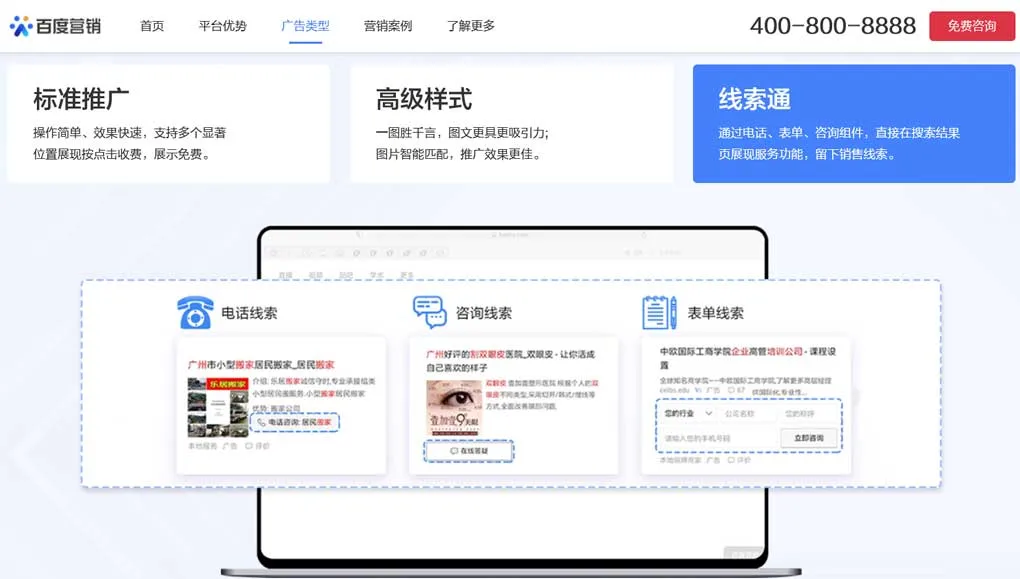
Baidu contact info ads
You can choose from text ads, image ads, and video ads. The format you pick depends on your campaign goal. Text ads work well for search intent. Image and video formats work better for brand awareness on the display network.
Every click sends the user to a landing page. That page can be a URL you own or a Baidu sub-page (Baidupages) built inside the platform. I almost always recommend using a dedicated Chinese landing page on your own domain. It builds trust and improves conversion.
Baidu Tuiguang: Setting Up Your Account
Baidu’s advertising platform is called Baidu Tuiguang (百度推广). To run ads, you need a verified Chinese business entity or a certified agency partner. Foreign brands without a Chinese entity must work through an authorized agent. This is where many brands get stuck early.
The account setup process involves business license submission, payment deposit (minimum around 5,000 RMB to start), and keyword selection. Allow 2-4 weeks for full verification if you are going through the process for the first time.
How the China Search Landscape Has Shifted
Baidu PPC does not exist in isolation anymore. In 2026, Chinese consumers discover beauty brands through multiple touchpoints before they ever run a search.
This means your Baidu campaign needs to be part of a broader acquisition plan. Here is what has changed that you need to account for:
AI-Powered Search on Baidu
Baidu has integrated its ERNIE AI model directly into search results. In 2026, AI-generated summaries now appear above standard paid results for many informational queries. This affects both organic rankings and ad visibility. For cosmetics brands, it means your keyword strategy must target transactional and brand-comparison queries where AI summaries are less dominant. Terms like “best retinol serum China buy” or “[brand name] review” still deliver solid paid traffic.
The Role of Xiaohongshu and Douyin in the Funnel
Chinese beauty consumers, especially women under 35, now start their product research on Xiaohongshu or Douyin before they search on Baidu. I’ve seen brands cut their Baidu CPC costs significantly by running Xiaohongshu marketing in parallel. When your brand already has awareness from XHS content, users who search on Baidu have higher intent and convert faster.
Douyin advertising has also matured. Short video pre-roll and in-feed ads drive brand recall that reinforces your Baidu spend. Think of it as priming the search query before the user even types it. Brands that run both channels see better cost-per-acquisition across the board.
Ingredient-Led Search Behavior
One of the biggest shifts I’ve noticed in Chinese cosmetics consumers is that they now search by ingredient, not just by brand. Queries like “烟酰胺精华” (niacinamide serum), “视黄醇抗衰” (retinol anti-aging), or “神经酰胺屏障修复” (ceramide barrier repair) drive significant volume. If your Baidu campaigns are only targeting brand and category terms, you are leaving traffic on the table.
Build a separate ad group for ingredient-led keywords. Write ad copy that speaks directly to the ingredient’s benefit. Link to a landing page that explains the science in plain Chinese. This approach consistently outperforms generic category targeting in my experience.
Consumer Behavior: What Has Changed
Chinese beauty consumers are more skeptical than they were three years ago. Post-pandemic, the focus has shifted toward efficacy, safety, and value. “成分党” (ingredient-focused consumers) represent a large and growing segment. They read labels, compare concentrations, and look for clinical data.
For international cosmetics brands, this is both a challenge and an opportunity. Brands that can credibly explain what their products do, and why their formulations are superior, win trust faster. Your Baidu landing pages need to carry this level of detail. Not a product brochure. An explanation that respects the consumer’s intelligence.
Price sensitivity has also increased. This is especially true in the 200-500 RMB skincare segment where competition is intense.
Step-by-Step: Running Your First Baidu Campaign
Step 1: Define Your Objective
Are you driving traffic to a product page, generating leads, or building brand awareness? Each goal requires a different campaign structure. Be specific before you touch the platform.
Step 2: Keyword Research in Chinese
Use Baidu’s keyword planning tool to identify search volume and CPC estimates. Focus on three tiers: brand terms (your brand name in Chinese), category terms (“外资护肤品” foreign skincare), and ingredient or problem-based terms (“敏感肌修复” sensitive skin repair). Do not run campaigns in English keywords expecting Chinese traffic.
Step 3: Build Your Ad Groups
Group keywords by intent and topic. Keep each ad group tight, 10-20 keywords maximum. Write at least two ad variations per group to test messaging. Your headline has 50 characters in Chinese. Use them well. State the benefit directly.
Step 4: Set Up Your Landing Page
This is where most foreign brands fail. A landing page in English, or a generic Chinese translation, will kill your conversion rate. The page needs Chinese-native copywriting, trust signals (certifications, press mentions, customer reviews in Chinese), and a clear call to action. WeChat contact, Tmall store link, or a form, your choice, but make it frictionless.
Step 5: Set Budget and Bids
Start with a daily budget that lets you collect data without overspending. I recommend at least 300-500 RMB per day for a meaningful test. Bid conservatively at first, then increase on keywords that convert. Use Baidu’s automated bidding tools only once you have enough conversion data to train the algorithm.
Step 6: Monitor, Adjust, Repeat
Check your campaigns daily for the first two weeks. Look at click-through rate, bounce rate on landing pages, and conversion rate. Pause keywords that spend without converting. Increase bids on terms that deliver results. Baidu PPC is not a set-and-forget channel. It rewards attention.
Integrating Baidu Ads into Your Full China Strategy
Baidu PPC works best when it is part of a connected approach. Brands that only run paid search in China typically see diminishing returns as costs rise. The brands that see sustained growth combine paid search with content-driven channels.
For cosmetics, that means publishing on Xiaohongshu, running KOL marketing China campaigns with credible beauty creators, and maintaining a presence on Douyin. These channels generate the brand awareness that makes your Baidu clicks cheaper and more likely to convert.
Is Baidu PPC Right for Your Brand?
I get this question often. My honest answer: if you are a foreign cosmetics brand entering China and you do not yet have strong organic rankings, Baidu PPC gives you immediate visibility while your SEO builds. If you already have traction on XHS or Douyin and want to capture users who are searching to buy, Baidu PPC is a direct conversion tool.
What it is not: a standalone strategy. Brands that pour budget into Baidu without a Chinese social presence, without localized content, and without a credible storefront (Tmall, JD, or a Chinese website) waste most of that spend. The click has nowhere good to go.
In 2026, China’s beauty market is more competitive than ever, but it also rewards brands that do the work properly. Baidu remains a core part of that work.