Beauty categories Men's beauty
Men's Beauty in China: How Foreign Cosmetic Brands Can Win the Male Market
6 min read
On this page
- The Numbers Behind China’s Male Beauty Boom
- Evolution of Chinese Male Beauty Standards: From Taboo to Mainstream
- Which Brands Are Winning the Chinese Male Beauty Market
- Where Chinese Men Discover and Buy Beauty Products
- The Role of Male KOLs and Live Streaming
- 5 Male Beauty Trends Shaping China’s Market
The Chinese male beauty market is no longer a niche. In 2025, it crossed RMB 8.5 billion in retail sales, growing at 18% year-on-year, more than three times the global average. Young Chinese men born after 2000 spend more on skincare and cosmetics than their female peers in several product categories. Foreign brands that treated this as a “future opportunity” in 2022 are now playing catch-up. The window is open, but it is closing fast.
The Numbers Behind China’s Male Beauty Boom
The growth figures are not soft projections. They are tracked purchase data from Tmall, JD, and Douyin’s commerce layer.
- Male skincare in China grew 22% in 2024, reaching RMB 6.1 billion (Mintel, 2025)
- Male makeup (BB cream, concealer, tinted moisturizer) grew 19% in the same period
- 73% of Gen Z Chinese men (born 2000-2006) report using at least one facial skincare product daily
- On Douyin, videos tagged #男生护肤 (men’s skincare) generated over 14 billion views in 2025
- Tmall’s Double 11 2025 data: male beauty products sold out faster than female skincare in 4 of the top 10 luxury brand stores
These are not vanity metrics. They translate directly into conversion rates and basket sizes that are hard to ignore.
Evolution of Chinese Male Beauty Standards: From Taboo to Mainstream
Ten years ago, a Chinese man buying concealer was hiding it. Today, he is posting the unboxing on Xiaohongshu.
The shift happened in layers. First came Korean soft power, through K-dramas and K-pop idols, which normalized male grooming and subtle makeup across East Asia. Then came the “Little Fresh Meat” (小鲜肉) phenomenon in Chinese pop culture: young male celebrities with flawless skin, styled for both female and male audiences. Celebrities like Xiao Zhan, Jackson Wang, and Cai Xukun turned beauty routines into aspirational content for millions of young men.
By 2024, the conversation on Zhihu and Xiaohongshu had shifted from “should men wear makeup?” to “which concealer gives the most natural finish?” The acceptance is no longer in question. The debate is now about product quality, brand values, and which influencer to trust.
The ideal still tends toward the invisible: a man who looks refreshed, clear-skinned, and polished without anyone being able to say he is wearing makeup. But in larger cities, Beijing, Shanghai, Chengdu, that line is blurring. Tinted lip balms, eyebrow gels, and light foundation are now common in the average urban male’s routine.
Which Brands Are Winning the Chinese Male Beauty Market
Some foreign brands moved early. Others are scrambling now.
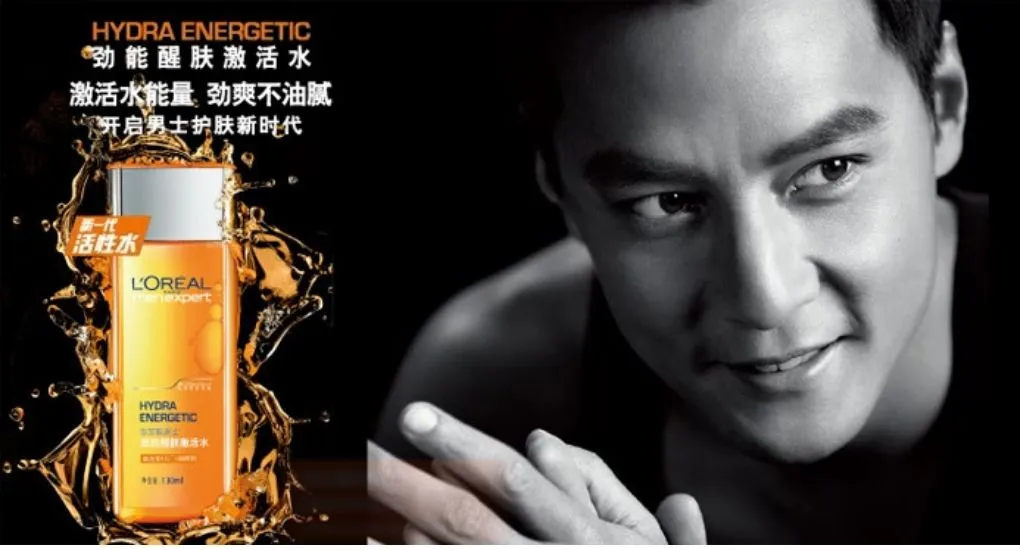
L’Oreal Men Expert is the market leader in mass male skincare on Tmall. They localized their messaging around oil control and SPF, two concerns that resonate specifically with Chinese male consumers. Their WeChat mini-program for personalized skincare routines has over 4 million registered users.
Chanel Boy de Chanel continues to grow. The line started with a Chinese model in the campaign and has since expanded to include a primer, a concealer stick, and a lip balm. The positioning is clear: invisible, effortless, luxury. It works because it does not ask Chinese men to identify as wearing makeup. It asks them to look their best.
Shiseido’s Men line dominates in the premium department store channel and on JD Luxury. Their strategy relies on education: in-store consultations, detailed product tutorials on Douyin, and partnerships with male KOLs who explain the “why” behind each product.
Domestic brands are also moving fast. Florasis (花西子) released a limited male-targeted collection in 2024. Judydoll launched a gender-neutral line that sold out within 72 hours on Xiaohongshu. Foreign brands need to watch these players. They are faster, cheaper, and deeply attuned to local aesthetics.
Where Chinese Men Discover and Buy Beauty Products
The purchase journey for Chinese male beauty consumers is almost entirely digital, and it is driven by content, not advertising.
Xiaohongshu (Little Red Book) is the discovery platform. Male skincare content performs exceptionally well here. Men search for routines, reviews, and comparisons. A brand without a presence on Xiaohongshu does not exist for this demographic. Posts from real users (UGC) drive more trust than polished brand content.
Douyin is where conversion happens at scale. A 60-second tutorial from a male KOL with 500,000 followers can sell out a product in hours. The Douyin advertising system also allows hyper-targeted campaigns by gender, age, and interest cluster. Running a male beauty campaign on Douyin without a native video strategy is a waste of budget.
WeChat handles retention. After the first purchase, brands that maintain a WeChat official account with useful content (routines, seasonal tips, ingredient explanations) see repurchase rates 3x higher than brands that do not.
Tmall and JD are the primary purchase platforms. But Chinese men also buy directly through Douyin’s in-app store, which grew 60% in 2025 for the beauty category.
The Role of Male KOLs and Live Streaming
Austin Li (李佳琦), the “Lipstick King,” is still active and still moves product. But the male beauty KOL space has expanded significantly. You no longer need to work with the biggest name in China to see results.
Mid-tier male beauty KOLs (100,000 to 2 million followers) are producing some of the highest ROI in the category. They are specific: one focuses on minimalist skincare for office workers, another on SPF and outdoor routines, another on “invisible makeup for job interviews.” This specificity drives trust.
For foreign brands, working with KOLs in China requires more than paying for posts. You need product briefing, authenticity, and a creator who genuinely understands your brand positioning. A luxury brand that sends product to a bargain-hunting KOL will damage its image, not build it.
Live streaming commerce in male beauty has also matured. Male hosts who explain ingredients, compare textures on camera, and answer live questions convert better than female hosts for male beauty products. The audience trusts a man explaining why a certain SPF does not leave a white cast.
5 Male Beauty Trends Shaping China’s Market
- SPF-first skincare: Chinese male consumers are now the fastest-growing SPF buyer segment. Air pollution awareness + outdoor lifestyle + influencer education have made sunscreen the gateway product for male beauty.
- Ingredient literacy: Men read labels now. Niacinamide, retinol, hyaluronic acid, these terms appear constantly in male skincare content. Brands that explain the “what and why” of ingredients win credibility.
- Gender-neutral positioning: More brands are moving away from “for men” packaging toward neutral aesthetics. This reduces stigma and expands the audience.
- Luxury male gifting: Male beauty products are now a top-3 gift category on Tmall during Valentine’s Day and Qixi. Packaging and gift sets matter.
- Scalp and hair care: The next frontier. Hair loss is a shared concern among Chinese men under 35. Brands entering this space now are establishing category leadership early.