E-commerce How beauty e-commerce works
Cosmetics Brand Website in China: 10 Strategies Next to Tmall
Updated 11 min read
On this page
- What a cosmetics brand website is for in China
- Strategies 1 to 3: decide the job before you build
- 1. Give the site one job: proof, not first sales
- 2. Put checkout where shoppers already pay
- 3. Pick the trade route before the storefront
- Strategies 4 to 7: make a direct purchase feel safe
- 4. Host in China, file, and show the numbers in the footer
- 5. Treat mini program filing as the launch date
- 6. Publish the product facts a shopper checks on Tmall
- 7. Answer in chat, during the session
- Strategies 8 to 10: discovery and CRM
- 8. Own your brand name on Baidu and WeChat Search
- 9. Turn first buyers into members, with consent
- 10. Let members reorder where they prefer
- When a China website is not worth it yet
- Planning your China storefront
- Frequently asked questions
At home, your brand website is a core sales channel. In China, the Tmall or Tmall Global store does the selling, and someone in the budget meeting asks whether a Chinese site is still worth building. A cosmetics brand website in China earns its place once three things are settled: its job, your trade route and the filings that let it go live. The ten strategies come in three groups, then a section on when to wait.
If you are planning a China storefront for a beauty brand, our e-commerce service for brands in China is the place to start.
What a cosmetics brand website is for in China
In China, a cosmetics brand website earns its keep as the place shoppers check the brand, not the place they pay. We would put checkout inside WeChat and leave volume to Tmall and Douyin. That checkout can be a WeChat mini program (微信小程序), an app the brand builds inside WeChat, or WeChat Mini Shop (微信小店), WeChat’s own store service.
| Channel | Main job | Shopper signs in with | Before launch | Best for |
|---|---|---|---|---|
| Brand website hosted in mainland China | Proof: brand story, Chinese product facts, store finder, member sign-up | The brand’s own account | ICP filing or licence; business licence and filing number on the homepage | Brands whose name shoppers already search |
| WeChat mini program or Mini Shop | Checkout, member offers, chat service | Their WeChat account | Mini program filing; WeChat Pay for a verified mini program | Repeat buyers, consultations, members |
| Tmall or Tmall Global flagship | Volume, festivals, search inside the marketplace | Their Taobao account | The platform’s own process for opening a Tmall Global store | First sales at scale |
| Douyin store | Sales from short video and live streams | Their Douyin account | The platform’s own process for opening a Douyin store | Content-led launches |
WeChat Pay’s product page, read in October 2026, offers verified mini programs a quick connection to WeChat Pay: that is what lets a brand’s own channel sell.
Our comparison of Chinese e-commerce platforms for beauty brands covers which marketplace to open first, and our hub on beauty e-commerce in China the other channels. Which channel may sell a given product depends on its trade route (more on that in strategy 3).
Strategies 1 to 3: decide the job before you build
Three decisions come before any design brief: the site’s job, where checkout lives, and the trade route.
1. Give the site one job: proof, not first sales
A brand website’s first job in China is to confirm the brand is real and to tell the shopper where to buy it. Our guide on how Chinese beauty shoppers search shows where that check starts.
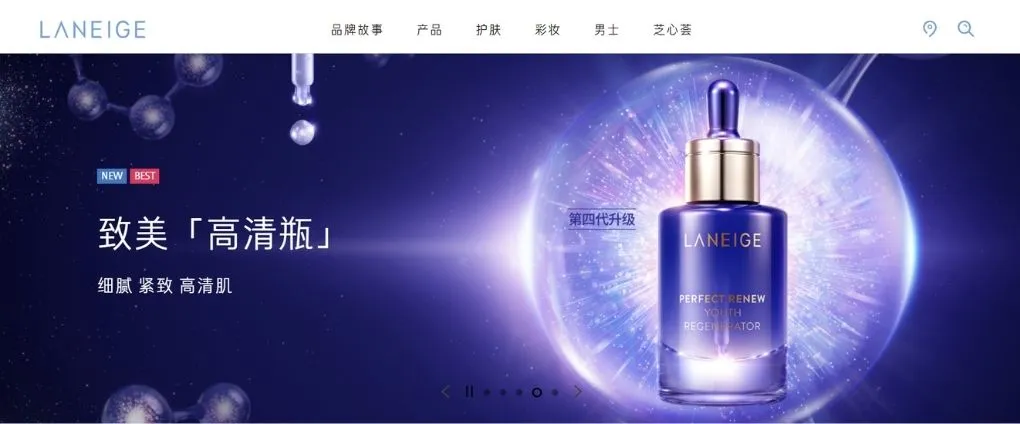
Laneige’s Chinese website, captured in 2021: brand story, ranges, store finder, no shopping cart.
The proof site carries the brand story and range in Chinese, the Tmall flagship link, the mini program code, launch pages and, for counter brands, a store finder.
We would not build a web checkout first: shoppers ready to pay already can, in WeChat or on Tmall, without a new account.
2. Put checkout where shoppers already pay
If the brand wants its own till in China, we would put it inside WeChat. Weixin and WeChat had 1,439 million combined monthly active users in the second quarter of 2026, according to Tencent’s results of 12 August 2026. A mini program runs inside that app.
The brand can build and file its own mini program, or open a WeChat Mini Shop. Our page on setting up WeChat commerce covers the mini program and WeChat Pay setup.
Mainland company required. Mini Shop’s entry rules, in force since 17 June 2026, do not yet accept legal entities registered outside mainland China.
Before signing with a developer, settle whose company name the mini program is registered and filed under: that decides who controls the store and member list.
Where this breaks: a brand with one hero product and little reason to buy again may do better with Tmall alone. A mini program lives on repeat visits.
3. Pick the trade route before the storefront
Your own store can only sell what your trade route allows. Under general trade, every imported general cosmetic must be filed with the NMPA before import, and every special cosmetic registered (Article 17).
That rule comes from China’s Cosmetics Supervision and Administration Regulation (State Council Order 727, in force since 1 January 2021). It keeps filing (备案) for general cosmetics apart from registration (注册) for special cosmetics (Article 4). Our guide to NMPA filing and registration shows which products fall where.
Cross-border e-commerce (CBEC) works differently. A notice of 28 November 2018 from the Ministry of Commerce and five other agencies treats CBEC retail imports as goods for the buyer’s own use. They skip first-import registration or filing, and the buyer may not resell them.
Your own storefront fits that regime only on a platform: the same notice defines CBEC retail as purchases through a third-party cross-border platform registered in China. Under customs Announcement No. 194 of 2018, the overseas seller also appoints a customs-registered domestic agent, and each order’s transaction, payment and logistics data go to customs. A brand mini program selling cross-border needs such a platform behind it, not just a payment button.
Cross-border caps. A CBEC purchase is capped at RMB 5,000 per order and RMB 26,000 per shopper per year. The caps come from a Ministry of Finance, customs and tax notice in force since 1 January 2019.
We would test demand cross-border first, on a Tmall Global store, and open an own store under general trade once the hero products are filed. See how to sell cosmetics in China for the full sequence, and cross-border e-commerce platforms for the stores on that route.
Strategies 4 to 7: make a direct purchase feel safe
Four signals make a direct purchase feel as safe as a Tmall order; two are legal duties anyway.
4. Host in China, file, and show the numbers in the footer
A website operated in mainland China falls under the Internet Information Services Measures (State Council Order 292 of 2000, Article 2). It needs an ICP filing (备案), or a licence (许可) if it is a commercial information service, before it serves anyone (Article 4). A revised draft of the Measures was out for comment in July 2026: check the text in force before filing.
Alibaba Cloud’s filing guide, updated in August 2026, ties the filing to mainland servers and accepts only a mainland-registered company or resident as filer. A foreign company with no mainland branch needs a registered representative office, which some provinces accept for a filing but not for a commercial licence.
Which regime fits a site selling only your own products is a question for your host. Selling through your own website also makes the brand an e-commerce operator under the E-commerce Law, in force since 1 January 2019 (Article 9), with its own homepage duty.
What the homepage footer shows:
- The ICP filing or licence number, shown prominently (Order 292, Article 12).
- The business licence information, or a link to it, shown continuously (E-commerce Law, Article 15).
- The public security filing number, filed on the Ministry of Public Security’s platform within 30 days of launch (Alibaba Cloud’s guidance).
- The Tmall flagship link and the mini program code, so shoppers see the channels belong together (our advice, not a legal duty).
5. Treat mini program filing as the launch date
A mini program cannot go live in China before it is filed. Notice No. 105 of the Ministry of Industry and Information Technology, dated 21 July 2023, bars unfiled apps from providing service, and its addressees include mini program platforms.
From 1 September 2023, WeChat required every new mini program to be filed before launch, according to a Jiemian News report carried by China National Radio on 10 August 2023. The mini program’s operator makes the filing, so the company name of strategy 2 matters again. Put the filing on the launch plan before any creative work.
No filing, no launch. WeChat said it would remove unfiled mini programs from 1 April 2024.
6. Publish the product facts a shopper checks on Tmall
Own-channel product pages should carry at least what the Tmall listing carries, in Chinese, because shoppers compare the two. The minimum we would publish:
- the Chinese product name
- the full ingredient list in Chinese
- the product’s filing or registration status
- skin type and usage guidance
- price, delivery and returns terms
Localise, do not translate: a name that reads like a translation tells the shopper the page was built abroad. Spell out returns and after-sales terms in full: no marketplace stands between shopper and brand. We would not publish a page that contradicts the Tmall listing.
7. Answer in chat, during the session
Put a chat or consultation button on every product page, and staff it during Chinese shopping hours. An email address alone is not customer service.
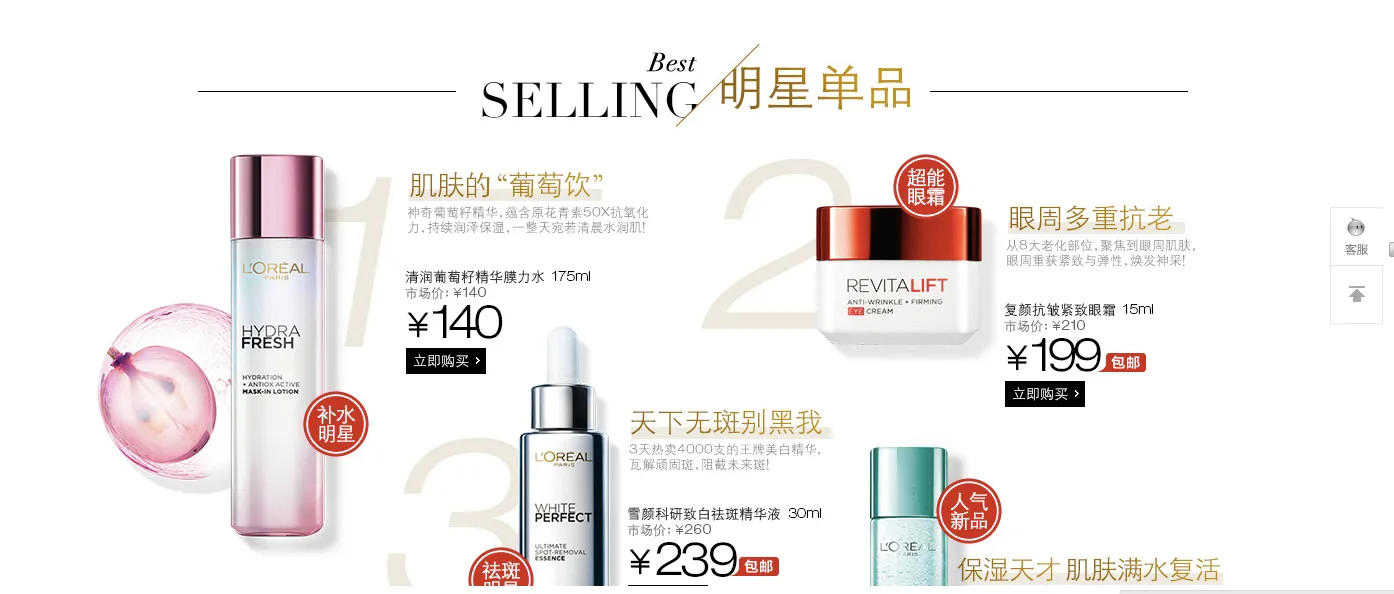
A Chinese L’Oréal Paris best-seller page, captured in August 2015.
Old as it is, we would still copy its layout: price, buy button and service tab on one screen. Inside WeChat, service happens in the chat the shopper already uses.
Strategies 8 to 10: discovery and CRM
Once the own channel can sell safely, its second job starts: catching the shopper who searched for the brand, and keeping the one who bought.
8. Own your brand name on Baidu and WeChat Search
When a shopper sees the brand on Xiaohongshu or Douyin and searches its name, the official site and the mini program should be what they find. Discovery happens through KOL marketing in China (key opinion leaders, the creators brands pay) and Xiaohongshu content.
On Baidu, the filed, China-hosted site of strategy 4 is the page to rank, and our guide to Baidu SEO for beauty brands covers how. Inside WeChat, the Official Account and the mini program are what surface in WeChat Search.
9. Turn first buyers into members, with consent
The own channel’s lasting value is the member list. A buyer who joins the brand’s mini program or Official Account can be reached again without paying a marketplace for the visit. The brand decides what members get: samples, skin consultations, launch previews.
Hotels offer a parallel. In February 2016, Hilton launched what it called its largest campaign ever, built on exclusive room rates it said were not found anywhere else (Hilton release, 16 February 2016). A mini program member offer plays the same part next to a Tmall flagship, though we would build it on perks rather than price. Our guide to a WeChat Official Account covers the account side.
Member data and the law. Sending members’ data to a CRM outside China needs one of the legal routes in Article 38 of the Personal Information Protection Law, in force since 1 November 2021. Article 39 adds each member’s separate consent, after telling them who receives the data and why. Since March 2024, data needed to perform a cross-border purchase is exempt from the security assessment, standard contract and certification (Cyberspace Administration of China, Order No. 16). A global CRM copy of every member is a separate question for counsel.
10. Let members reorder where they prefer
Measure the own channel by members and repeat buyers, not by its share of sales. A member who reorders on the Tmall flagship still counts. Member offers live in the mini program, festival volume on your Tmall flagship. The questions below give our view on prices across the two.
When a China website is not worth it yet
Skip the China-hosted site for now if no company can file it, the products sell only cross-border, or one hero product gives no reason to return.
Build now if:
- the hero products are filed for general trade
- shoppers already search the brand name
- someone can answer chat in China
Wait if:
- the brand is in a cross-border test
- no mainland company, office or partner can hold the filings
- nobody can staff service during Chinese shopping hours
A waiting brand still needs a place for searchers: a Chinese-language section on the global site, tested from the mainland, plus a Tmall Global store and an Official Account. One exception to the list: a brand with department-store counters may need a store-finder site before any e-commerce, because the counter is where its shoppers buy.
Planning your China storefront
Once strategy 3 has settled your trade route and strategies 4 and 5 your filing order, put site, mini program and flagship in sequence. Our case studies show the brands we have worked with. For storefront planning, see our China e-commerce service; for the mini program and membership, our WeChat agency service. Get in touch when you know which group you start from.
Frequently asked questions
What is the difference between an ICP filing and an ICP licence?
Under State Council Order 292 (Articles 3 and 4), paid information or web-production services are commercial and need a licence (许可). Free, public information needs a filing (备案).
Alibaba Cloud's commercial filing page (updated September 2026) puts the filing first, then the licence, applied for at the provincial communications administration. Ask your host which one your site needs.
Is a WeChat Mini Shop the same as a mini program?
No. A mini program (微信小程序) is an app the brand builds, registers and files before launch. WeChat Mini Shop (微信小店) is WeChat's own store service: the brand opens it through a company in mainland China instead of building it.
With that company in place, we would start with Mini Shop for checkout and build a mini program once membership needs its own features.
Will our global website work for visitors in China?
Test it from mainland China, on your shoppers' mobile networks, before deciding. Alibaba Cloud's filing guide (updated August 2026) says a site hosted outside the mainland needs no ICP filing. It still asks for the public security filing of strategy 4 when such a site serves mainland users.
If the test fails, the fix is a China-hosted version and its ICP filing.
Should prices on our own site match the Tmall flagship?
Our view: match the list price, and reward members with samples, gifts or consultations rather than discounts. The mini program then gives shoppers a reason to join without teaching Tmall buyers to wait for a cheaper channel.